Saturday, November 26, 2011

Le Chatelier's Principle

Le Chatelier's Principle

It is of great practical importance to be able to predict, and to control, the equilibrium composition of a chemical reaction. In an industrial process it may be desirable to convert as much as possible of reactants to prodcuts. At equilibrium the product yield may not be satisfactory. But, the composition of the equilibrium mixture (equilibrium position) is dependent on certain conditions, such as temperature and pressure, and it might be possible to change these to achieve a better yield. Le Chatelier's Principle helps us deal with this.
Now consider another chemical reaction in a state of equilibrium at a constant temperature.
N2(g)   +   3H2(g)        2NH3(g)    DH°f, 298 = - 46.0 kJ mol-1
In a closed system and at a pressure of 250 atmospheres in the presence of a finely divided iron catalyst at 500 °C, about 15 percent of the gases are converted into ammonia at equilibrium.
We can impose the following changes [both an increase and decrease] upon this chemical system at equilibrium:
  1. Amount of a substance / concentration of a reactant or product.
  2. Pressure / Volume (pressure and volume are inversely related).
  3. Temperature.

In general terms, this is what Le Chatelier's Principle says...

If a change is imposed upon a chemical system at equilibrium then it will respond in such a way as to undo, in part, the effect of the change imposed upon it.

Chemical Bonding.

Chemical Bonding.

Though the periodic table has only 118 or so elements, there are obviously more substances in nature than 118 pure elements. This is because atoms can react with one another to form new substances called compounds (see our Chemical Reactions module). Formed when two or more atoms chemically bond together, the resulting compound is unique both chemically and physically from its parent atoms.
Let's look at an example.  The element sodium is a silver-colored metal that reacts so violently with water that flames are produced when sodium gets wet.  The element chlorine is a greenish-colored gas that is so poisonous that it was used as a weapon in World War I.  When chemically bonded together, these two dangerous substances form the compound sodium chloride, a compound so safe that we eat it every day - common table salt!
In 1916, the American chemist Gilbert Newton Lewis proposed that chemical bonds are formed between atoms because electrons from the atoms interact with each other. Lewis had observed that many elements are most stable when they contain eight electrons in their valence shell. He suggested that atoms with fewer than eight valence electrons bond together to share electrons and complete their valence shells.
While some of Lewis' predictions have since been proven incorrect (he suggested that electrons occupy cube-shaped orbitals), his work established the basis of what is known today about chemical bonding. We now know that there are two main types of chemical bonding; ionic bonding and covalent bonding.

Ionic bonding

In ionic bonding, electrons are completely transferred from one atom to another. In the process of either losing or gaining negatively charged electrons, the reacting atoms form ions. The oppositely charged ions are attracted to each other by electrostatic forces, which are the basis of the ionic bond.
For example, during the reaction of sodium with chlorine:
Sodium&Chlorine-transfer sodium (on the left) loses its one           valence electron to chlorine (on the right),    


arrow-down resulting in
SodiumChlorineIons a positively charged sodium ion (left) and a negatively charged chlorine ion (right
The reaction of sodium with chlorine
Concept simulation - Reenacts the reaction of sodium with chlorine.

Notice that when sodium loses its one valence electron it gets smaller in size, while chlorine grows larger when it gains an additional valence electron. This is typical of the relative sizes of ions to atoms. Positive ions tend to be smaller than their parent atoms while negative ions tend to be larger than their parent. After the reaction takes place, the charged Na+ and Cl- ions are held together by electrostatic forces, thus forming an ionic bond. Ionic compounds share many features in common:
  • Ionic bonds form between metals and nonmetals.
  • In naming simple ionic compounds, the metal is always first, the nonmetal second (e.g., sodium chloride).
  • Ionic compounds dissolve easily in water and other polar solvents.
  • In solution, ionic compounds easily conduct electricity.
  • Ionic compounds tend to form crystalline solids with high melting temperatures.
This last feature, the fact that ionic compounds are solids, results from the intermolecular forces (forces between molecules) in ionic solids. If we consider a solid crystal of sodium chloride, the solid is made up of many positively charged sodium ions (pictured below as small gray spheres) and an equal number of negatively charged chlorine ions (green spheres). Due to the interaction of the charged ions, the sodium and chlorine ions are arranged in an alternating fashion as demonstrated in the schematic. Each sodium ion is attracted equally to all of its neighboring chlorine ions, and likewise for the chlorine to sodium attraction. The concept of a single molecule does not apply to ionic crystals because the solid exists as one continuous system. Ionic solids form crystals with high melting points because of the strong forces between neighboring ions.
NaCl-crystal
Cl-1 Na+1 Cl-1 Na+1 Cl-1
Na+1 Cl-1 Na+1 Cl-1 Na+1
Cl-1 Na+1 Cl-1 Na+1 Cl-1
Na+1 Cl-1 Na+1 Cl-1 Na+1
Sodium Chloride Crystal NaCl Crystal Schematic

Covalent bonding

The second major type of atomic bonding occurs when atoms share electrons. As opposed to ionic bonding in which a complete transfer of electrons occurs, covalent bonding occurs when two (or more) elements share electrons. Covalent bonding occurs because the atoms in the compound have a similar tendency for electrons (generally to gain electrons). This most commonly occurs when two nonmetals bond together. Because both of the nonmetals will want to gain electrons, the elements involved will share electrons in an effort to fill their valence shells. A good example of a covalent bond is that which occurs between two hydrogen atoms. Atoms of hydrogen (H) have one valence electron in their first electron shell. Since the capacity of this shell is two electrons, each hydrogen atom will "want" to pick up a second electron. In an effort to pick up a second electron, hydrogen atoms will react with nearby hydrogen (H) atoms to form the compound H2. Because the hydrogen compound is a combination of equally matched atoms, the atoms will share each other's single electron, forming one covalent bond. In this way, both atoms share the stability of a full valence shell.
Covalent bonding between hydrogen atoms
Concept simulation - Recreates covalent bonding between hydrogen atoms.

Unlike ionic compounds, covalent molecules exist as true molecules. Because electrons are shared in covalent molecules, no full ionic charges are formed.  Thus covalent molecules are not  strongly attracted to one another.  As a result, covalent molecules move about freely and tend to exist as liquids or gases at room temperature. 
Multiple Bonds: For every pair of electrons shared between two atoms, a single covalent bond is formed.  Some atoms can share multiple pairs of electrons, forming multiple covalent bonds.  For example, oxygen (which has six valence electrons) needs two electrons to complete its valence shell.  When two oxygen atoms form the compound O2, they share two pairs of electrons, forming two covalent bonds. 
Lewis Dot Structures: Lewis dot structures are a shorthand to represent the valence electrons of an atom. The structures are written as the element symbol surrounded by dots that represent the valence electrons. The Lewis structures for the elements in the first two periods of the periodic table are shown below.
lewis_H Lewis Dot Structures lewis_He
lewis_Li lewis_Be lewis_B lewis_C lewis structure-nitrogen lewis_O lewis_F lewis_Ne
Lewis structures can also be used to show bonding between atoms. The bonding electrons are placed between the atoms and can be represented by a pair of dots or a dash (each dash represents one pair of electrons, or one bond). Lewis structures for H2 and O2 are shown below.
H2 H:H or H-H
O2 lewis structure - oxygen3 lewis structure - oxygen3 lewis structure - oxygen2

Polar and nonpolar covalent bonding

There are, in fact, two subtypes of covalent bonds. The H2 molecule is a good example of the first type of covalent bond, the nonpolar bond. Because both atoms in the H2 molecule have an equal attraction (or affinity) for electrons, the bonding electrons are equally shared by the two atoms, and a nonpolar covalent bond is formed. Whenever two atoms of the same element bond together, a nonpolar bond is formed.
A polar bond is formed when electrons are unequally shared between two atoms. Polar covalent bonding occurs because one atom has a stronger affinity for electrons than the other (yet not enough to pull the electrons away completely and form an ion). In a polar covalent bond, the bonding electrons will spend a greater amount of time around the atom that has the stronger affinity for electrons. A good example of a polar covalent bond is the hydrogen-oxygen bond in the water molecule.
water molecule - 3D - H2O: a water molecule
H2O: a water molecule
Water molecules contain two hydrogen atoms (pictured in red) bonded to one oxygen atom (blue). Oxygen, with six valence electrons, needs two additional electrons to complete its valence shell. Each hydrogen contains one electron. Thus oxygen shares the electrons from two hydrogen atoms to complete its own valence shell, and in return shares two of its own electrons with each hydrogen, completing the H valence shells.
                                                                                                                                                              Polar covalent bonding simulated in water
The primary difference between the H-O bond in water and the H-H bond is the degree of electron sharing. The large oxygen atom has a stronger affinity for electrons than the small hydrogen atoms. Because oxygen has a stronger pull on the bonding electrons, it preoccupies their time, and this leads to unequal sharing and the formation of a polar covalent bond.  

The dipole

Because the valence electrons in the water molecule spend more time around the oxygen atom than the hydrogen atoms, the oxygen end of the molecule develops a partial negative charge (because of the negative charge on the electrons). For the same reason, the hydrogen end of the molecule develops a partial positive charge. Ions are not formed; however, the molecule develops a partial electrical charge across it called a dipole. The water dipole is represented by the arrow in the pop-up animation (above) in which the head of the arrow points toward the electron dense (negative) end of the dipole and the cross resides near the electron poor (positive) end of the molecule.

Thursday, November 24, 2011

compressors

A gas compressor is a mechanical device that increases the pressure of a gas by reducing its volume.
Compressors are similar to pumps: both increase the pressure on a fluid and both can transport the fluid through a pipe. As gases are compressible, the compressor also reduces the volume of a gas. Liquids are relatively incompressible, while some can be compressed, the main action of a pump is to pressurize and transport liquids.

Types of compressors

The main types of gas compressors are illustrated and discussed below:
Compressor Types.png

Hermetically sealed, open, or semi-hermetic


A small hermetically sealed compressor in a common consumer refrigerator or freezer; it typically has a rounded steel outer shell that is permanently welded shut, and which seals operating gases inside the system. There is no route for gases to leak, such as around motor shaft seals. On this model, the plastic top section is part of an auto-defrost system which uses motor heat to evaporate the water.
Compressors are often described as being either open, hermetic, or semi-hermetic, to describe how the compressor and motor drive is situated in relation to the gas or vapour being compressed. The industry name for a hermetic is hermetically sealed compressor, while a semi- is commonly called a semi-hermetic compressor.
In hermetic and most semi-hermetic compressors, the compressor and motor driving the compressor are integrated, and operate within the pressurized gas envelope of the system. The motor is designed to operate and be cooled by the gas or vapour being compressed.
The difference between the hermetic and semi-hermetic, is that the hermetic uses a one-piece welded steel casing that cannot be opened for repair; if the hermetic fails it is simply replaced with an entire new unit. A semi-hermetic uses a large cast metal shell with gasketed covers that can be opened to replace motor and pump components.
The primary advantage of a hermetic and semi-hermetic is that there is no route for the gas to leak out of the system. Open compressors rely on either natural leather or synthetic rubber seals to retain the internal pressure, and these seals require a lubricant such as oil to retain their sealing properties.
An open pressurized system such as an automobile air conditioner can leak its operating gases, if it is not operated frequently enough. Open systems rely on lubricant in the system to splash on pump components and seals. If it is not operated frequently enough, the lubricant on the seals slowly evaporates, and then the seals begin to leak until the system is no longer functional and must be recharged. By comparison, a hermetic system can sit unused for years, and can usually be started up again at any time without requiring maintenance or experiencing any loss of system pressure.
The disadvantage of hermetic compressors is that the motor drive cannot be repaired or maintained, and the entire compressor must be removed if a motor fails. A further disadvantage is that burnt out windings can contaminate whole systems requiring the system to be entirely pumped down and the gas replaced. Typically hermetic compressors are used in low-cost factory-assembled consumer goods where the cost of repair is high compared to the value of the device, and it would be more economical to just purchase a new device.
An advantage of open compressors is that they can be driven by non-electric power sources, such as an internal combustion engine or turbine. However, open compressors that drive refrigeration systems are generally not totally maintenance free throughout the life of the system, since some gas leakage will occur over time.

Centrifugal compressors


Figure 1: A single stage centrifugal compressor
Centrifugal compressors use a rotating disk or impeller in a shaped housing to force the gas to the rim of the impeller, increasing the velocity of the gas. A diffuser (divergent duct) section converts the velocity energy to pressure energy. They are primarily used for continuous, stationary service in industries such as oil refineries, chemical and petrochemical plants and natural gas processing plants. Their application can be from 100 horsepower (75 kW) to thousands of horsepower. With multiple staging, they can achieve extremely high output pressures greater than 10,000 psi (69 MPa).
Many large snowmaking operations  use this type of compressor. They are also used in internal combustion engines as superchargers and turbochargers. Centrifugal compressors are used in small gas turbine engines or as the final compression stage of medium sized gas turbines. Sometimes the capacity of the compressors is written in NM3/hr. Here 'N' stands for normal temperature pressure (20°C and 1 atm ) for example 5500 NM3/hr.

Diagonal or mixed-flow compressors

Diagonal or mixed-flow compressors are similar to centrifugal compressors, but have a radial and axial velocity component at the exit from the rotor. The diffuser is often used to turn diagonal flow to an axial rather than radial direction.

Axial-flow compressors


An animation of an axial compressor.
Axial-flow compressors are dynamic rotating compressors that use arrays of fan-like airfoils to progressively compress the working fluid. They are used where there is a requirement for a high flow rate or a compact design.
The arrays of airfoils are set in rows, usually as pairs: one rotating and one stationary. The rotating airfoils, also known as blades or rotors, accelerate the fluid. The stationary airfoils, also known as stators or vanes, decelerate and redirect the flow direction of the fluid, preparing it for the rotor blades of the next stage. Axial compressors are almost always multi-staged, with the cross-sectional area of the gas passage diminishing along the compressor to maintain an optimum axial Mach number. Beyond about 5 stages or a 4:1 design pressure ratio, variable geometry is normally used to improve operation.
Axial compressors can have high efficiencies; around 90% polytropic at their design conditions. However, they are relatively expensive, requiring a large number of components, tight tolerances and high quality materials. Axial-flow compressors can be found in medium to large gas turbine engines, in natural gas pumping stations, and within certain chemical plants.

Reciprocating compressors


A motor-driven six-cylinder reciprocating compressor that can operate with two, four or six cylinders.
Reciprocating compressors use pistons driven by a crankshaft. They can be either stationary or portable, can be single or multi-staged, and can be driven by electric motors or internal combustion engines. Small reciprocating compressors from 5 to 30 horsepower (hp) are commonly seen in automotive applications and are typically for intermittent duty. Larger reciprocating compressors well over 1,000 hp (750 kW) are commonly found in large industrial and petroleum applications. Discharge pressures can range from low pressure to very high pressure (>18000 psi or 180 MPa). In certain applications, such as air compression, multi-stage double-acting compressors are said to be the most efficient compressors available, and are typically larger, and more costly than comparable rotary units. Another type of reciprocating compressor is the swash plate compressor, which uses pistons which are moved by a swash plate mounted on a shaft - see Axial Piston Pump.
Household, home workshop, and smaller job site compressors are typically reciprocating compressors 1½ hp or less with an attached receiver tank.

Rotary screw compressors


Diagram of a rotary screw compressor
Rotary screw compressors use two meshed rotating positive-displacement helical screws to force the gas into a smaller space. These are usually used for continuous operation in commercial and industrial applications and may be either stationary or portable. Their application can be from 3 horsepower (2.2 kW) to over 1,200 horsepower (890 kW) and from low pressure to moderately high pressure (>1,200 psi or 8.3 MPa).
Rotary screw compressors are commercially produced in Oil Flooded, Water Flooded and Dry type.

Rotary vane compressors

Rotary vane compressors consist of a rotor with a number of blades inserted in radial slots in the rotor. The rotor is mounted offset in a larger housing which can be circular or a more complex shape. As the rotor turns, blades slide in and out of the slots keeping contact with the outer wall of the housing. Thus, a series of decreasing volumes is created by the rotating blades. Rotary Vane compressors are, with piston compressors one of the oldest of compressor technologies.
With suitable port connections, the devices may be either a compressor or a vacuum pump. They can be either stationary or portable, can be single or multi-staged, and can be driven by electric motors or internal combustion engines. Dry vane machines are used at relatively low pressures (e.g., 2 bar or 200 kPa; 29 psi) for bulk material movement while oil-injected machines have the necessary volumetric efficiency to achieve pressures up to about 13 bar (1,300 kPa; 190 psi) in a single stage. A rotary vane compressor is well suited to electric motor drive and is significantly quieter in operation than the equivalent piston compressor.
Rotary vane compressors can have mechanical efficiencies of about 90%.

Scroll compressors
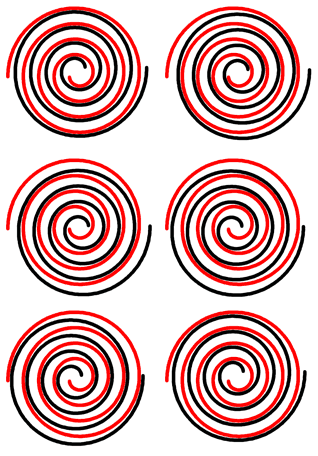

Mechanism of a scroll pump
A scroll compressor, also known as scroll pump and scroll vacuum pump, uses two interleaved spiral-like vanes to pump or compress fluids such as liquids and gases. The vane geometry may be involute, archimedean spiral, or hybrid curves. They operate more smoothly, quietly, and reliably than other types of compressors in the lower volume range.
Often, one of the scrolls is fixed, while the other orbits eccentrically without rotating, thereby trapping and pumping or compressing pockets of fluid or gas between the scrolls.
This type of compressor was used as the supercharger on Volkswagen G60 and G40 engines in the early 1990s.

Diaphragm compressors

A diaphragm compressor (also known as a membrane compressor) is a variant of the conventional reciprocating compressor. The compression of gas occurs by the movement of a flexible membrane, instead of an intake element. The back and forth movement of the membrane is driven by a rod and a crankshaft mechanism. Only the membrane and the compressor box come in contact with the gas being compressed.
The degree of flexing and the material constituting the diaphragm affects the maintenance life of the equipment. Generally stiff metal diaphragms may only displace a few cubic centimeters of volume because the metal can not endure large degrees of flexing without cracking, but the stiffness of a metal diaphragm allows it to pump at high pressures. Rubber or silicone diaphragms are capable of enduring deep pumping strokes of very high flexion, but their low strength limits their use to low-pressure applications, and they need to be replaced as plastic embrittlement occurs.
Diaphragm compressors are used for hydrogen and compressed natural gas (CNG) as well as in a number of other applications.

A three-stage diaphragm compressor
The photograph included in this section depicts a three-stage diaphragm compressor used to compress hydrogen gas to 6,000 psi (41 MPa) for use in a prototype compressed hydrogen and compressed natural gas (CNG) fueling station built in downtown Phoenix, Arizona by the Arizona Public Service company (an electric utilities company). Reciprocating compressors were used to compress the natural gas.
The prototype alternative fueling station was built in compliance with all of the prevailing safety, environmental and building codes in Phoenix to demonstrate that such fueling stations could be built in urban areas.

Air bubble compressor

Also known as a trompe. A mixture of air and water generated through turbulence is allowed to fall into a subterranean chamber where the air separates from the water. The weight of falling water compresses the air in the top of the chamber. A submerged outlet from the chamber allows water to flow to the surface at a lower height than the intake. An outlet in the roof of the chamber supplies the compressed air to the surface. A facility on this principal was built on the Montreal River at Ragged Shutes near Cobalt, Ontario in 1910 and supplied 5,000 horsepower to nearby mines.

Temperature

Compression of a gas naturally increases its temperature, often referred to as the heat of compression. W = \int_{V_1}^{V_2} P dV = P_1 V_1^n \int_{V_1}^{V_2} V^{-n} dV where
\frac { P_2 }{ P_1 }\ = \left( \frac{ v_1 } { v_2 }\ \right) ^ n
so
W = \frac {{P_1} {V_1^n}} {1-n}\ ( {V_2^{1-n}} - {V_1^{1-n}} )
with n taking different values for different compression processes (see below).
  • Adiabatic - This model assumes that no energy (heat) is transferred to or from the gas during the compression, and all supplied work is added to the internal energy of the gas, resulting in increases of temperature and pressure. Theoretical temperature rise is-
 T_2 = T_1 . {R_c}^{(k-1)/k} with T1 and T2 in degrees Rankine or kelvins, and k = ratio of specific heats (approximately 1.4 for air). Rc is the compression ratio; being the absolute outlet pressure divided by the absolute inlet pressure. The rise in air and temperature ratio means compression does not follow a simple pressure to volume ratio. This is less efficient, but quick. Adiabatic compression or expansion more closely model real life when a compressor has good insulation, a large gas volume, or a short time scale (i.e., a high power level). In practice there will always be a certain amount of heat flow out of the compressed gas. Thus, making a perfect adiabatic compressor would require perfect heat insulation of all parts of the machine. For example, even a bicycle tire pump's metal tube becomes hot as you compress the air to fill a tire. The relation between temperature and compression ratio described above means that the value of n for an adiabatic process is k (the ratio of specific heats).
  • Isothermal - This model assumes that the compressed gas remains at a constant temperature throughout the compression or expansion process. In this cycle, internal energy is removed from the system as heat at the same rate that it is added by the mechanical work of compression. Isothermal compression or expansion more closely models real life when the compressor has a large heat exchanging surface, a small gas volume, or a long time scale (i.e., a small power level). Compressors that utilize inter-stage cooling between compression stages come closest to achieving perfect isothermal compression. However, with practical devices perfect isothermal compression is not attainable. For example, unless you have an infinite number of compression stages with corresponding intercoolers, you will never achieve perfect isothermal compression.
For an isothermal process, n is 1, so the value of the work integral for an isothermal process is:
W = - {P_1} {v_1} \ln \left( \frac {P_2} {P_1}\ \right)
When evaluated, the isothermal work is found to be lower than the adiabatic work.
  • Polytropic - This model takes into account both a rise in temperature in the gas as well as some loss of energy (heat) to the compressor's components. This assumes that heat may enter or leave the system, and that input shaft work can appear as both increased pressure (usually useful work) and increased temperature above adiabatic (usually losses due to cycle efficiency). Compression efficiency is then the ratio of temperature rise at theoretical 100 percent (adiabatic) vs. actual (polytropic). Polytropic compression will use a value of n between 0 (a constant-pressure process) and infinity (a constant volume process). For the typical case where an effort is made to cool the gas compressed by an approximately adiabatic process, the value of n will be between 1 and k.

Staged compression

In the case of centrifugal compressors, commercial designs currently do not exceed a compression ratio of more than a 3.5 to 1 in any one stage (for a typical gas). Since compression generates heat, the compressed gas is to be cooled between stages making the compression less adiabatic and more isothermal. The inter-stage coolers typically result in some partial condensation that is removed in vapor-liquid separators.
In the case of small reciprocating compressors, the compressor flywheel may drive a cooling fan that directs ambient air across the intercooler of a two or more stage compressor.
Because rotary screw compressors can make use of cooling lubricant to remove the heat of compression, they very often exceed a 9 to 1 compression ratio. For instance, in a typical diving compressor the air is compressed in three stages. If each stage has a compression ratio of 7 to 1, the compressor can output 343 times atmospheric pressure (7 × 7 × 7 = 343 atmospheres). (343 atm/34.8 MPa; 5.04 ksi)

Prime movers

There are many options for the "prime mover" or motor which powers the compressor:
  • gas turbines power the axial and centrifugal flow compressors that are part of jet engines
  • steam turbines or water turbines are possible for large compressors
  • electric motors are cheap and quiet for static compressors. Small motors suitable for domestic electrical supplies use single phase alternating current. Larger motors can only be used where an industrial electrical three phase alternating current supply is available.
  • diesel engines or petrol engines are suitable for portable compressors and support compressors. Common in automobiles and other types of vehicles (including piston-powered airplanes, boats, trucks, etc.), diesel or gasoline engines can power compressors using their own crankshaft power (this setup known as a supercharger), or, using their waste exhaust gas to spin a turbine connected to the compressor (this setup known as a turbocharger).
Applications Gas compressors are used in various applications where either higher pressures or lower volumes of gas are needed:

  • in pipeline transport of purified natural gas to move the gas from the production site to the consumer. Often, the compressor in this application is driven by a gas turbine which is fueled by gas bled from the pipeline. Thus, no external power source is necessary.
  • in petroleum refineries, natural gas processing plants, petrochemical and chemical plants, and similar large industrial plants for compressing intermediate and end product gases.
  • in refrigeration and air conditioner equipment to move heat from one place to another in refrigerant cycles: see Vapor-compression refrigeration.
  • in gas turbine systems to compress the intake combustion air
  • in storing purified or manufactured gases in a small volume, high pressure cylinders for medical, welding and other uses.
  • in many various industrial, manufacturing and building processes to power all types of pneumatic tools.
  • as a medium for transferring energy, such as to power pneumatic equipment.
  • in pressurised aircraft to provide a breathable atmosphere of higher than ambient pressure.
  • in some types of jet engines (such as turbojets and turbofans) to provide the air required for combustion of the engine fuel. The power to drive the combustion air compressor comes from the jet's own turbines.
  • in SCUBA diving, hyperbaric oxygen therapy and other life support devices to store breathing gas in a small volume such as in diving cylinders.
  • in surface supplied diving an air compressor is frequently used to supply low pressure air (10 to 20 bar) to the diver for breathing
  • in submarines, to store air for later use in displacing water from buoyancy chambers, for adjustment of depth.
  • in turbochargers and superchargers to increase the performance of internal combustion engines by increasing mass flow.
  • in rail and heavy road transport to provide compressed air for operation of rail vehicle brakes or road vehicle brakes and various other systems (doors, windscreen wipers, engine/gearbox control, etc.).
  • in miscellaneous uses such as providing compressed air for filling pneumatic tires.
  • in the case of the fire piston and the heat pump, the desired outcome is the temperature rise of the gas, and compressing the gas is only a means to that end.

The Periodic Table

The Periodic Table

The first periodic table was devised by Dmitri Mendeleev and published in 1869.
Mendeleev found he could arrange the 65 elements that were then known in a grid or table so that each element had:
1. A higher atomic weight than the one on its left.
2. Similar chemical properties to other elements in the same column.
He realized that the table in front of him lay at the very heart of chemistry. In his table he noted gaps - spaces where elements should be but none had yet been discovered.
In fact, just as Adams and Le Verrier could be said to have discovered the planet Neptune on paper, Mendeleev could be said to have discovered germanium (which he called eka-silicon because he observed a gap between silicon and tin), gallium (eka-aluminum) and scandium (eka-boron) on paper, for he predicted their existence and their properties before their actual discoveries.
Although Mendeleev had made a crucial breakthrough, he made little further progress because the Rutherford-Bohr model of the atom had not yet been formulated.
In 1913, Henry Moseley, who worked with Rutherford, showed that it is atomic number (electric charge) which is most fundamental to the chemical properties of any element. Mendeleev had believed chemical properties were determined by atomic weight. Moseley correctly predicted the existence of new elements based on atomic numbers.
Today the chemical elements are still arranged in order of increasing atomic number (Z) as you go from left to right across the table. We call the horizontal rows periods and the vertical rows groups.
We also know now that an element's chemistry is determined by the way its electrons are arranged - its electron configuration.
The noble gases are found in group 18, on the far right of each period. The reluctance of the noble gases to undergo chemical reactions indicates that the atoms of these gases strongly prefer their own electron configurations - featuring a full outer shell of electrons - to any other.
In contrast to the noble gases, the elements with the highest reactivity are those with the greatest need to gain or lose electrons in order to achieve a full outer shell of electrons.
Elements that sit in the same group (e.g. the alkali metals in Group 1) all have the same number of outer electrons, leading to similar chemical properties.
Likewise the halogens in Group 17 also have similar properties to one another. When halogens react, they gain an electron to form negatively charged ions. Each ion has the same electron configuration as the noble gas in the same period. The ions are therefore more chemically stable than the elements from which they formed.
There is a progression from metals to non-metals across each period.
The block of elements in groups 3 - 12 contains the transition metals. These are similar to one another in many ways: they produce colored compounds, have variable valency and are often used as catalysts.
Then we come to the lanthanides (elements 58 - 71) and actinides (elements 90 - 103). The lanthanides are often called the rare earth elements, although in fact these elements are not rare. The actinides include most of the well-known elements that take part in or are produced by nuclear reactions. No element with atomic number higher than 92 occurs naturally in large quantities. Tiny amounts of plutonium and neptunium exist in nature as decay products of uranium. These elements, and higher elements, are also produced artificially in nuclear reactors or particle accelerators.

Monday, November 21, 2011

Centrifugal Pumps

A centrifugal pump converts the input power to kinetic energy in the liquid by accelerating the liquid by a revolving device - an impeller. The most common type is the volute pump. Fluid enters the pump through the eye of the impeller which rotates at high speed. The fluid is accelerated radially outward from the pump chasing. A vacuum is created at the impellers eye that continuously draws more fluid into the pump.
The energy created by the pump is kinetic energy according the Bernoulli Equation. The energy transferred to the liquid corresponds to the velocity at the edge or vane tip of the impeller. The faster the impeller revolves or the bigger the impeller is, the higher will the velocity of the liquid energy transferred to the liquid be. This is described by the Affinity Laws.

Pressure and Head

If the discharge of a centrifugal pump is pointed straight up into the air the fluid will pumped to a certain height -  or head - called the shut off head. This maximum head is mainly determined by the outside diameter of the pump's impeller and the speed of the rotating shaft. The head will change as the capacity of the pump is altered.
The kinetic energy of a liquid coming out of an impeller is obstructed by creating a resistance in the flow. The first resistance is created by the pump casing which catches the liquid and slows it down. When the liquid slows down the kinetic energy is converted to pressure energy.
  • it is the resistance to the pump's flow that is read on a pressure gauge attached to the discharge line
A pump does not create pressure, it only creates flow. Pressure is a measurement of the resistance to flow.
In Newtonian fluids (non-viscous liquids like water or gasoline) the term head is used to measure the kinetic energy which a pump creates. Head is a measurement of the height of the liquid column the pump creates from the kinetic energy the pump gives to the liquid.
  • the main reason for using head instead of pressure to measure a centrifugal pump's energy is that the pressure from a pump will change if the specific gravity (weight) of the liquid changes, but the head will not
The pump's performance on any Newtonian fluid can always be described by using the term head.

Different Types of Pump Head

  • Total Static Head -  Total head when the pump is not running
  • Total Dynamic Head (Total System Head) - Total head when the pump is running
  • Static Suction Head - Head on the suction side, with pump off, if the head is higher than the pump impeller
  • Static Suction Lift - Head on the suction side, with pump off, if the head is lower than the pump impeller
  • Static Discharge Head - Head on discharge side of pump with the pump off
  • Dynamic Suction Head/Lift - Head on suction side of pump with pump on
  • Dynamic Discharge Head - Head on discharge side of pump with pump on
The head is measured in either feet or meters and can be converted to common units for pressure as psi or bar.
  • it is important to understand that the pump will pump all fluids to the same height if the shaft is turning at the same rpm
The only difference between the fluids is the amount of power it takes to get the shaft to the proper rpm. The higher the specific gravity of the fluid the more power is required.
  • Centrifugal Pumps are "constant head machines"
Note that the latter is not a constant pressure machine, since pressure is a function of head and density. The head is constant, even if the density (and therefore pressure) changes.
The head of a pump in metric units can be expressed in metric units as:
h = (p2 - p1)/(ρ  g) + v22/(2 g)         (1)
where
h = total head developed (m) 
p2 = pressure at outlet (N/m2)
p1 = pressure at inlet (N/m2)
ρ =   density (kg/m3)
g = acceleration of gravity (9.81)  m/s2
v2 = velocity at the outlet (m/s)
Head described in simple terms
  • a pump's vertical discharge "pressure-head" is the vertical lift in height - usually measured in feet or m of water - at which a pump can no longer exert enough pressure to move water. At this point, the pump may be said to have reached its "shut-off" head pressure. In the flow curve chart for a pump the "shut-off head" is the point on the graph where the flow rate is zero

Pump Efficiency

Pump efficiency, η (%) is a measure of the efficiency with wich the pump transfers useful work to the fluid.
η = Pin/Pout   (2)
where 
η = efficiency (%)
Pin = power input
Pout = power output 

Sunday, November 20, 2011

what is the difference between unit operation and unit process

unit operation involves a physical change examples drying, size reduction, distillation, filtration etc.
where as unit process involves a chemical change or sometime it refered as chemical changes along with physical change example production of paracetamol from benzene.


                                                                 OR


In unit process there is no any physical changes but chemical changes occur. but in unit operation no any chemical changes, only physical changes occur.

Saturday, November 19, 2011

The Water Cycle-

The Water Cycle: Evaporation

Picture of a electricity power-production plant showing that evaporation is used to cool the hot water coming from the plants.Evaporation is the process by which water changes from a liquid to a gas or vapor. Evaporation is the primary pathway that water moves from the liquid state back into the water cycle as atmospheric water vapor. Studies have shown that the oceans, seas, lakes, and rivers provide nearly 90 percent of the moisture in the atmosphere via evaporation, with the remaining 10 percent being contributed by plant transpiration.
A very small amount of water vapor enters the atmosphere through sublimation, the process by which water changes from a solid (ice or snow) to a gas, bypassing the liquid phase. This often happens in the Rocky Mountains as dry and warm Chinook winds blow in from the Pacific in late winter and early spring. When a Chinook takes effect local temperatures rise dramatically in a matter of hours. When the dry air hits the snow, it changes the snow directly into water vapor, bypassing the liquid phase. Sublimation is a common way for snow to disappear quickly in arid climates. (Source: Mount Washington Observatory)

Why evaporation occurs

Heat (energy) is necessary for evaporation to occur. Energy is used to break the bonds that hold water molecules together, which is why water easily evaporates at the boiling point (212° F, 100° C) but evaporates much more slowly at the freezing point. Net evaporation occurs when the rate of evaporation exceeds the rate of condensation. A state of saturation exists when these two process rates are equal, at which point the relative humidity of the air is 100 percent. Condensation, the opposite of evaporation, occurs when saturated air is cooled below the dew point (the temperature to which air must be cooled at a constant pressure for it to become fully saturated with water), such as on the outside of a glass of ice water. In fact, the process of evaporation removes heat from the environment, which is why water evaporating from your skin cools you.

Evaporation drives the water cycle

Photo showing evaporation from a pond.Evaporation from the oceans is the primary mechanism supporting the surface-to-atmosphere portion of the water cycle. After all, the large surface area of the oceans (over 70 percent of the Earth's surface is covered by the oceans) provides the opportunity for large-scale evaporation to occur. On a global scale, the amount of water evaporating is about the same as the amount of water delivered to the Earth as precipitation. This does vary geographically, though. Evaporation is more prevalent over the oceans than precipitation, while over the land, precipitation routinely exceeds evaporation. Most of the water that evaporates from the oceans falls back into the oceans as precipitation. Only about 10 percent of the water evaporated from the oceans is transported over land and falls as precipitation. Once evaporated, a water molecule spends about 10 days in the air. The process of evaporation is so great that without precipitation runoff, and groundwater discharge from aquifers, oceans would become nearly empty.
Notice the fog layer above the lake in this picture. Really, this is a cloud that has formed—evaporated water from the pond has condensed right above the water surface. Because the wind conditions are calm, the fog layer is just hanging around. If it was a windy day, especially if the air mass was dry, then you might not see the fog layer. But, even though you would not see the fog, in fact, more water could be evaporating from the pond, although invisibly. On a calm day, the fog layer hanging above the pond surface holds highly-humid air, and so less water from the pond is evaporating into it. If a dry wind was present, then the wind would be blowing the pond evaporation away and replacing it with less-humid air, into which the pond would find it easier to evaporate itself into.

People make use of evaporation

Picture of evaporation ponds at the Dead Sea, used for the extraction table salt and minerals.If you ever find yourself stranded on an island in need of some salt, just grab a bowl, add some seawater, and wait for the sun to evaporate the water. In fact, much of the world's table salt is produced within evaporation ponds, a technique used by people for thousands of years.
Salt is not the only product that people obtain using evaporation. Seawater contains other valuable minerals that are easily obtained by evaporation. The Dead Sea is located in the Middle East within a closed watershed and without any means of outflow, which is abnormal for most lakes. The primary mechanism for water to leave the lake is by evaporation, which can be quite high in a desert—upwards of 1,300 - 1,600 millimeters per year. The result is that the waters of the Dead Sea have the highest salinity and density (which is why you float "higher" when you lay in the water) of any sea in the world, too high to support life. The water is ideal for locating evaporation ponds for the extraction of not only table salt, but also magnesium, potash, and bromine. (Source: Overview of Middle East Water Resources, Middle East Water Data Banks Project ).

Evaporative cooling: Cheap air conditioning!

Map showing where evaporative cooling can work.We said earlier that heat is removed from the environment during evaporation, leading to a net cooling; notice how cold your arm gets when a physician rubs it with alcohol before pulling out a syringe with that scary-looking needle attached. In climates where the humidity is low and the temperatures are hot, an evaporator cooler, such as a "swamp cooler" can lower the air temperature by 20 degrees F., while it increases humidity. As this map shows, evaporative coolers work best in the dry areas of the United States (red areas marked A) and can work somewhat in the blue areas marked B. In the humid eastern U.S., normal air conditioners must be used.
Evaporative coolers are really quite simple devices, at least compared to air conditioners. Swamp coolers pull in the dry, hot outdoor air and pass it through an evaporative pad that is kept wet by a supply of water. As a fan draws the air through the pad, the water in the pad evaporates, resulting in cooler air which is pumped through the house. Much less energy is used as compared to an air conditioner. (Source: California Energy Commission)

Friday, November 18, 2011

Evaporators

Evaporators-

Evaporators are used for reducing product volume, remove water prior to drying, and to improve product storage life. 

Evaporation is a highly energy-efficient way of removing water or other liquids and thus the primary process for the production of concentrates. Process time can be shortened by distributing the liquid to a greater surface area, or by using a higher temperature. Higher temperatures combined with longer residence times can, however, cause degrading of many foodstuffs.

Types of Evaporators-

Falling Film Tubular Evaporators

The Falling Film Tubular Evaporator consists of one or more vertical tubular heat exchangers with vapor separator, condenser and pumps.

Process
Evaporation takes place under vacuum, atmospheric pressure, positive, or a combination depending on product heat sensitivity and viscosity. Usually, vacuum is involved.
The process liquor to be evaporated is distributed uniformly as a film along the inside of the heat exchanger tubes. Steam (or vapor) is applied on the heating media side of the tubes in an amount suitable for the required evaporation.
Heat is transferred through the tube wall to the liquor, which starts boiling at a temperature corresponding to the pressure inside the tubes.
The concentrate and vapor flow from the bottom of the tubes to a separator, where they are separated. The concentrate is pumped out from the bottom of the separator, while vapor is condensed in a condenser or in the next stage.


Forced Circulation Evaporators

The Forced Circulation evaporator is designed for evaporation of liquids with a high solids content, high viscosity, tendency to foul, and also for crystallizers.

Process-
The system is often used as a finishing evaporator for concentration of liquids to a high solids content following a low solids multistage evaporator.
Boiling in the Forced Circulation evaporator is suppressed in the heat exchanger by back pressure and takes place when the liquid enters the lower pressing separator champer.

Applications

Typical applications include processes for salt, still-age, corn steep water, Calcium carbonate and crystallizing evaporators.

Gas Heated Evaporators

Gas heated evaporators achieve extremely high energy-efficiency by tapping the energy contained in off-gasses from existing plant operations instead of using steam. 

Process
In many cases off-gasses from existing plant operations such as dryers or scrubbers contain valuable energy which may be recovered as the energy source for gas heated evaporators.
Gas-heated evaporators consume considerably less energy than steam heated or mechanically driven alternatives. They also enable additional evaporative capacity without increasing energy costs.

Applications
Proven for more than 20 years in corn wet milling and alcohol processing, the gas-heated evaporator also has high potential for distilling, brewery operations and pharmaceutical production involving high volume fermentation processes.

Natural Circulation Evaporators

Natural circulation evaporators utilize vertical tubes which operate by the thermo siphon principle. 
ProcessThe density difference between the boiling liquor and the circulating liquor produces the driving force for liquid circulation.  In operation, feed enters the lower liquor chamber. As it travels up the tubes and reaches boiling point, vapor forms and carries liquor to the separator. 
Most installations require liquor recirculation. When feed quantities are sufficient, however, single pass operation is utilized.

ApplicationsTypical applications include anhydrous caustic, beet sugar, foamy liquors, low or moderately viscous liquors and precipitating liquids.

Recirculated Falling Film Evaporators

Recirculated falling film evaporators are used where insufficient feed liquor is available to utilize the heat transfer surface with single pass operation.

Process
A portion of the product liquor is combined with the feed stream and is pumped to the upper liquor chamber.  Product retention time is greater than for the single pass F.F. evaporator but is relatively short as the operating volume is small.

Applications
Typical applications include many moderately heat sensitive food, pharmaceutical and chemical applications.


Single Pass Falling Film Evaporators

Single pass falling film evaporators assure controlled retention time operation while avoiding internal recirculation. 

ProcessFeed liquor enters the upper liquor chamber where it is distributed to the tubes.  As the liquor travels down the tubes, a portion is vaporized.  The remaining liquor and vapor discharge from the bottom of the tubes. 
The liquor being processed is in contact with the heating surface for only a short time. Single pass operation also results in small operating volumes allowing start up and shutdown to be performed quickly.

Applications
Typical applications are concentration of dairy products, sugars and syrups, fruit juices, ammonium nitrate, pharmaceuticals and other heat sensitive materials.

Thursday, November 17, 2011

Scrubbers


Scrubber
Scrubber systems are a diverse group of air pollution control devices that can be used to remove some particulates and/or gases from industrial exhaust streams. Traditionally, the term "scrubber" has referred to pollution control devices that used liquid to "scrub" unwanted pollutants from a gas stream. Recently, the term is also used to describe systems that inject a dry reagent or slurry into a dirty exhaust stream to "scrub out" acid gases. Scrubbers are one of the primary devices that control gaseous emissions, especially acid gases.

Removal and Neutrallising-


The exhaust gases of combustion may at times contain substances considered harmful to the environment, and it is the job of the scrubber to either remove those substances from the exhaust gas stream, or to neutralize those substances so that they cannot do any harm once emitted into the environment as part of the exhaust gas stream...

Wet scrubbing-
A wet scrubber is used to clean air or other gases of various pollutants and dust particles. Wet scrubbing works via the contact of target compounds or particulate matter with the scrubbing solution. Solutions may simply be water (for dust) or complex solutions of reagents that specifically target certain compounds.            
Removal efficiency of pollutants is improved by increasing residence time in the scrubber or by the increase of surface area of the scrubber solution by the use of a spray nozzle, packed towers or an aspirator. Wet scrubbers will often significantly increase the proportion of water in waste gases of industrial processes which can be seen in a stack plume.
Compliance agencies typically place minimum DP thresholds on wet scrubber.
         
Dry Scrubbing-      
A dry or semi-dry scrubbing system, unlike the wet scrubber, does not saturate the flue gas stream that is being treated with moisture. In some cases no moisture is added; while in other designs only the amount of moisture that can be evaporated in the flue gas without condensing is added. Therefore, dry scrubbers do not have a stack steam plume or wastewater handling/disposal requirements. Dry scrubbing systems are used to remove acid gases (such as SO2 and HCl) primarily from combustion sources.                                                                                                    
           There are a number of dry type scrubbing system designs. However, all consist of two main sections or devices: a device to introduce the acid gas asorbent material into the gas stream and a particulate matter control device to remove reaction products, excess sorbent material as well as any particulate matter already in the flue gas.Dry scrubbing systems can be categorized as dry sorbent injectors (DSIs) or as spray dryer absorbers (SDAs). Spray dryer absorbers are also called semi-dry scrubbers or spray dryers. 
                                    
Mercury removal-                                                                                                      Mercury has no known beneficial uses in nature, but it is a common substance found in coal that must also be removed. Wet scrubbers are only effective for mercury removal under certain conditions. Mercury vapor in its elemental form, Hg0, is insoluble in the scrubber slurry and not removed. Oxidized mercury, Hg2+, compounds are more soluble in the scrubber slurry and can be captured. The type of coal burned as well as the presence of a selective catalytic reduction unit both affect the ratio of elemental to oxidized mercury in the flue gas and thus the degree to which the mercury is removed.
  • Wet scrubber
o    Baffle spray scrubber
o    Ejector venturi scrubber
o    Mechanically aided scrubber
o    Spray tower
o    Spray Nozzle
o    Venturi scrubber